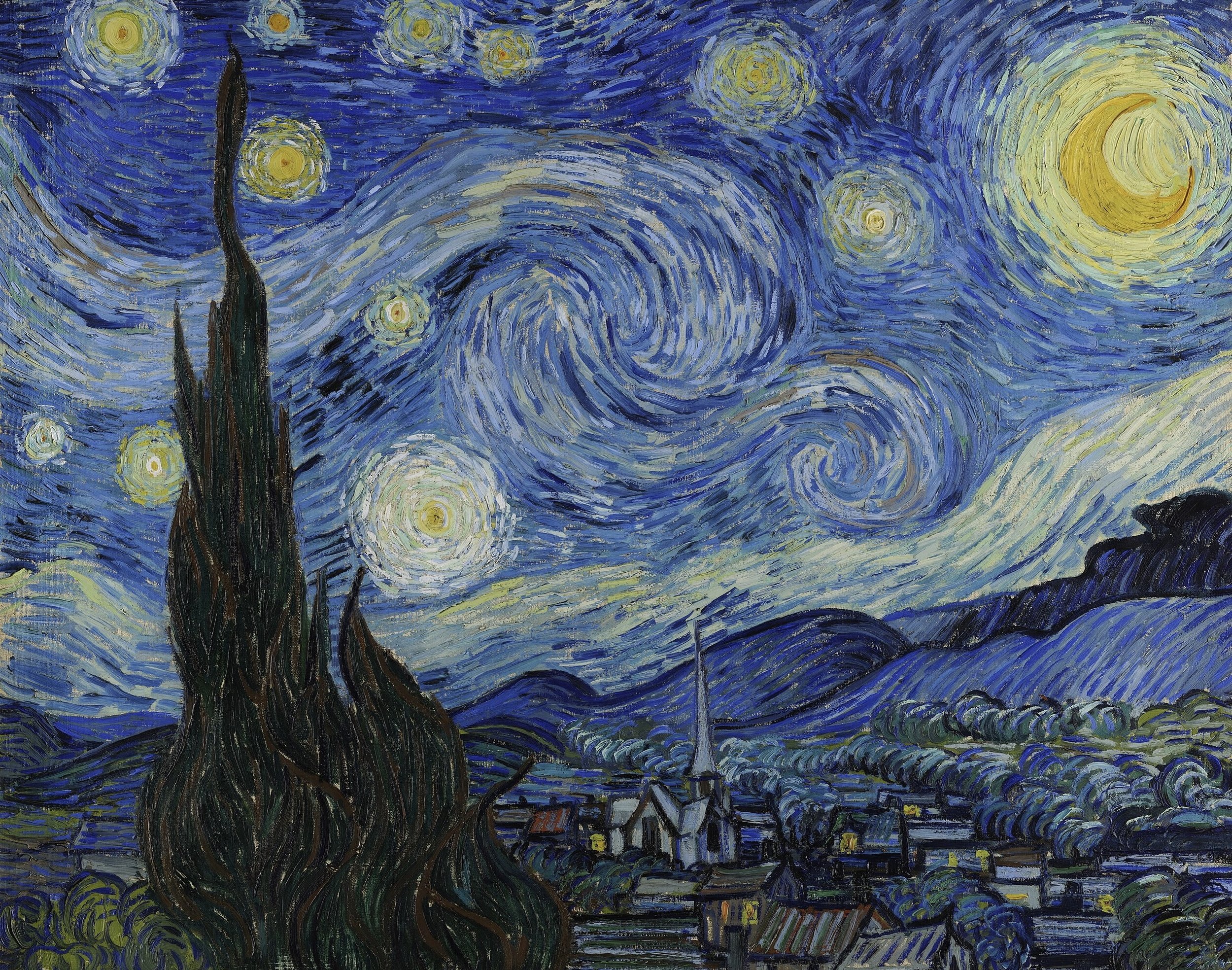
Vincent van Gogh — The Starry Night (1889)
Beyond What Is Visible
We live by trusting what we can see.
Appearance, wealth, social status— even the carefully curated fragments of life displayed on social media often become the standards by which we judge a person’s worth or the meaning of a thing.
What is visible offers reassurance.
It allows us to reach conclusions quickly, without lingering in uncertainty.
And so, almost unconsciously, we learn to rely on what is seen.
But what we see is never the whole.
Surface-level information may give us grounds for judgment, but it rarely opens the door to understanding.
We define people and situations by what appears on the outside, and in doing so, we easily overlook the deeper context and quiet truths that lie beneath the surface.
In The Little Prince, the reason the prince leaves his flower behind is precisely this:
he remains at the surface, reacting only to the Rose’s thorny words and her demanding, difficult attitude.
Only after he leaves does understanding begin to take shape.
Behind the vanity and unpredictability was a fragile longing to be loved— a vulnerability that did not yet know how to express itself with tenderness.
The Rose did not act difficult out of malice.
Fearing she might lose the love she cherished, she chose the defensive language of thorns.
And the Little Prince, in his youth, was not yet mature enough to interpret that love beyond its outward expression.
Yet the reason the Rose ultimately becomes irreplaceable is not because she was the most beautiful flower in the universe.
It was the water he gave her.
The screen he placed to shield her from the wind.
The time and devotion he spent simply waiting by her side.
This invisible accumulation of care is what rendered the Rose irreplaceable.
When we fail to see beneath the surface, life begins to feel hollow.
Like a beautiful flower without scent, we find ourselves surrounded by brilliance without depth— relationships and achievements that glitter, yet carry no lasting substance within.
The ability to see essence is not innate.
It is cultivated— through the courage to suspend judgment, the empathy to imagine another’s inner life, and the willingness to ask what lies beyond what is immediately apparent.
As the world moves faster and increasingly saturated with striking images, we may need, at times, to close our eyes— to restore the vision of the heart.
“To see rightly with the heart” is not a sentimental phrase.
It is a challenge to recalibrate the foundations of how we judge the world.
A call to resist defining people and life solely by appearances, outcomes, or surface-level certainty.
And it leaves us with a question worth holding.
If even reading the subtle movements of our own hearts is difficult, how rare—and precious—it is to perceive the full depth of another.
What lens are you using to see the world? Your eyes—or your heart?
“It is only with the heart that one can see rightly; what is essential is invisible to the eye.”
— Antoine de Saint-Exupéry, The Little Prince