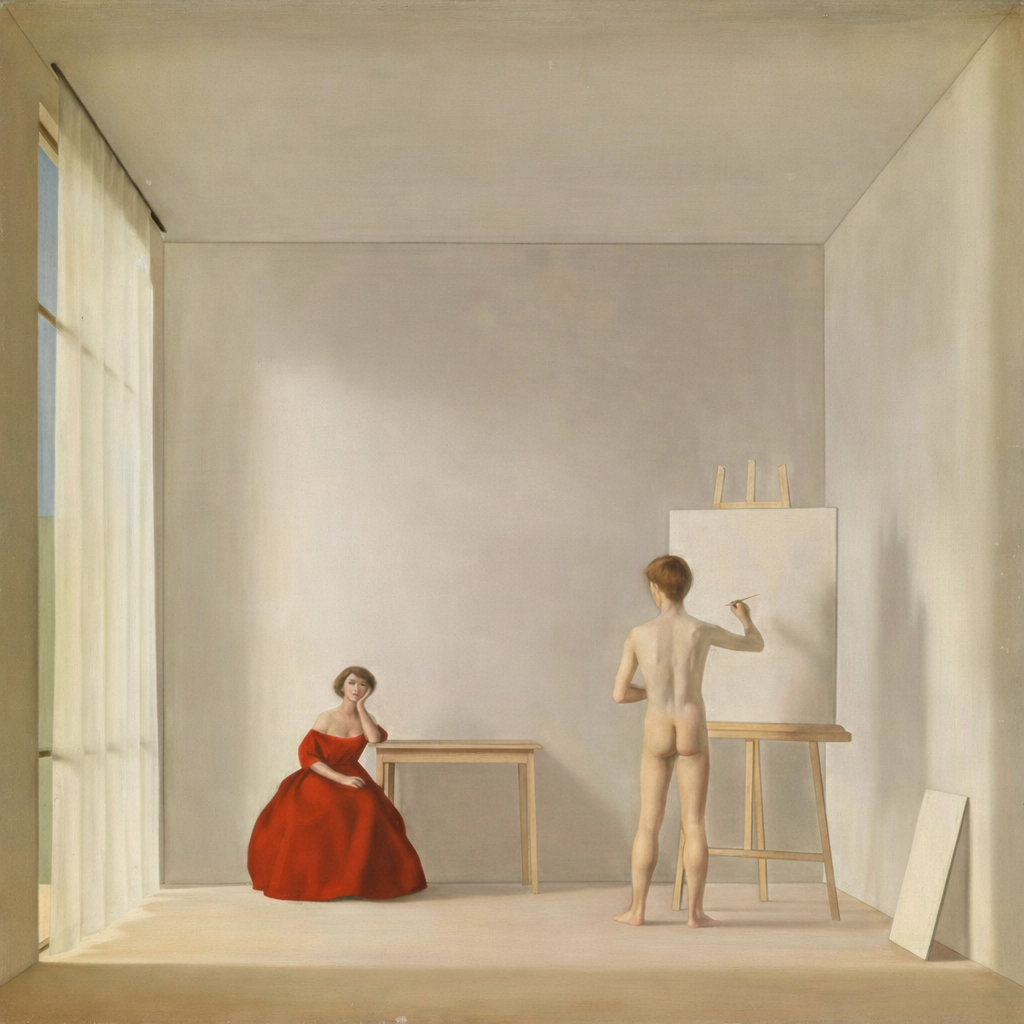
Image: Antonio Bueno — The Painter and the Model (1952)
A World on Auto-Play
One of the most enduring tableaus in Western art history is the sight of a fully clothed male painter standing before a nude female model.
Within this familiar frame,
the man appears as the one who observes and defines —the subject.
The woman appears as the one who is observed and preserved —the object.
We have looked at this asymmetrical gaze for so long that it has come to feel like a natural order, an unquestioned arrangement of the world.
The painter is assumed to be the one in control —the interpreter, the authority, the one who decides how reality will appear on canvas.
The model, by contrast, is reduced to a figure to be looked at, a subordinate presence, a paid object of vision.
But is that really true?
What if the opposite is just as possible?
What if the painter, so confident on the surface, is quietly hollowed out by insecurity and performance?
What if the model, silent and still, is the one who carries a deeper calm, a steadier sense of being, a quieter, more grounded existence?
Then why didn’t we see that possibility?
What we thought we were seeing as “the order of reality” —was it reality at all?
Or was it just a subtitle automatically generated by our perception?
The moment we stood before this image, we had already summoned an interpretation:
The painter must be the one in control.
The model must be the one exposed.
We weren’t just looking at a painting.
We were replaying a script we didn’t know we wrote.
And this is not a story confined to a gallery wall.
A man must be strong;
if he weeps, a caption appears:
“Why is he like that?”
A woman must be gentle; if she is firm, the subtitle reads:
“She’s too aggressive.”
We estimate power by position.
We infer character from appearance.
We measure the depth of a person by the shallowness of their assigned role.
We don’t do this deliberately.
It simply auto-plays.
Stereotypes are often defended as tools for efficiency —mental shortcuts for navigating a complex world.
But in truth, they are the thickest walls standing between us and reality.
Every time we meet someone, we are not actually seeing them.
We are fitting them into a frame already stored in our minds.
And then we mistake that frame for reality itself.
We are not really seeing the world.
We are living with subtitles constantly projected onto it.
The danger is that all of this happens unconsciously.
We don’t feel like we’re being biased.
It just feels normal.
It feels like “the way things are.”
But is it really the way things are?
Or is it just the way we’ve been trained to see them?
Every day, we encounter countless people and sort them, without noticing, into binaries:
Painter or Model.
Subject or Object.
Normal or Other.
In that instant of classification, a complex, three-dimensional human being is flattened into a single image.
We don’t judge.
We just press play.
What we call “natural,” “obvious,” or “just the way it is” may be nothing more than a default setting we never questioned.
We aren’t interpreting the world.
We are replaying an interpretation.
And yet, there is quiet power in noticing this.
That what feels like reality is often nothing more than unconscious auto-play.
That single awareness is enough to switch it off.
Because once the subtitles fade, we finally begin to see the person underneath.
So today —who did you place a subtitle over?
What you thought you were seeing —was it reality?
Or was it your perception quietly generating its own captions?
“We have no knowledge of things as they are in themselves,
but only as they appear to us.”
— Immanuel Kant, Critique of Pure Reason