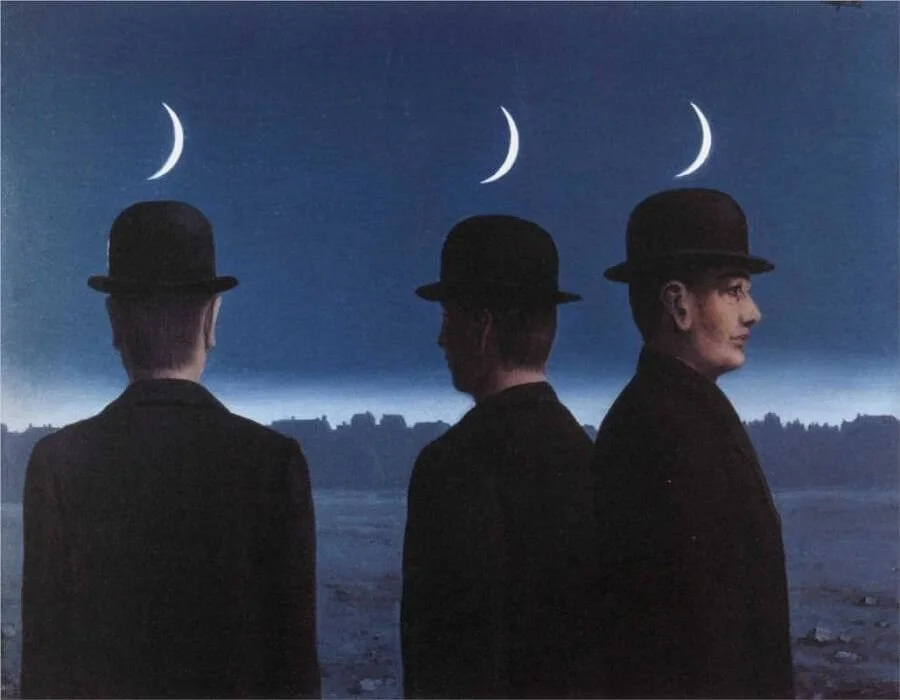
René Magritte — The Masterpiece of the Horizon (1955)
Truth vs. Perspective
We often collide with others believing that what we see is the only truth.
We reassure ourselves that our judgments are objective,
our interpretations rational,
and our discomfort entirely justified.
But is it?
The same words are spoken,
yet one person feels wounded,
another feels nothing at all.
The same situation unfolds,
yet one trembles with anger,
another watches in silence,
another walks past without a second thought.
The world has not changed.
Only the position from which we are looking has.
And yet, we so easily mistake our own position for the standard.
Most conflicts we encounter are not collisions of facts.
They begin at the moment each perspective insists on calling itself truth.
Perspective is not a matter of right or wrong.
It is a matter of angle and distance.
Still, instead of understanding that difference, we cover it with judgment.
What we usually see is not the world as it is, but the world as it appears from where we stand.
That place is layered with what we were taught,
with images society has repeated,
with roles and expectations quietly piled on top of one another.
And so we come to believe, almost effortlessly, that “this is just how things are.”
But change the question, and a different landscape appears.
Was it always this way?
Or were we trained to see it this way?
When perspective hardens into truth, we lose the chance to understand others—and retreat instead into a fortress of self-defense.
The despair you faced today:
was it an undeniable fact, or a point of view shaped by anxiety?
The anger you felt toward someone: was it their unchanging nature, or an opinion refracted through your expectations?
If what we see is not truth but merely one perspective, then paradoxically, we gain the power to redesign our lives.
What lies beyond the horizon may not be the most important thing.
What matters is this:
which direction you choose to turn your gaze,
what kind of moon you decide to place above your own head.
That choice determines the tone and density of your life.
There is no purely objective world.
There is only the sum of the perspectives we have chosen to live by.
At times, instead of blaming the world or another person, stand quietly and look at your own moon.
Truth is not out there.
It always lingers at the edge of your gaze.
So where is your horizon facing today?
The thought you call “truth” that has been weighing on you—could it be nothing more than an opinion you have temporarily hung in your own night sky?
“Everything is what you judge it to be.”
— Marcus Aurelius, Meditations (12.22)