Erased Studio
OPEN SECTION. 2026
열린 섹션. 2026 Erased Studio (벨기에)
중앙홀, Void — 전환의 축
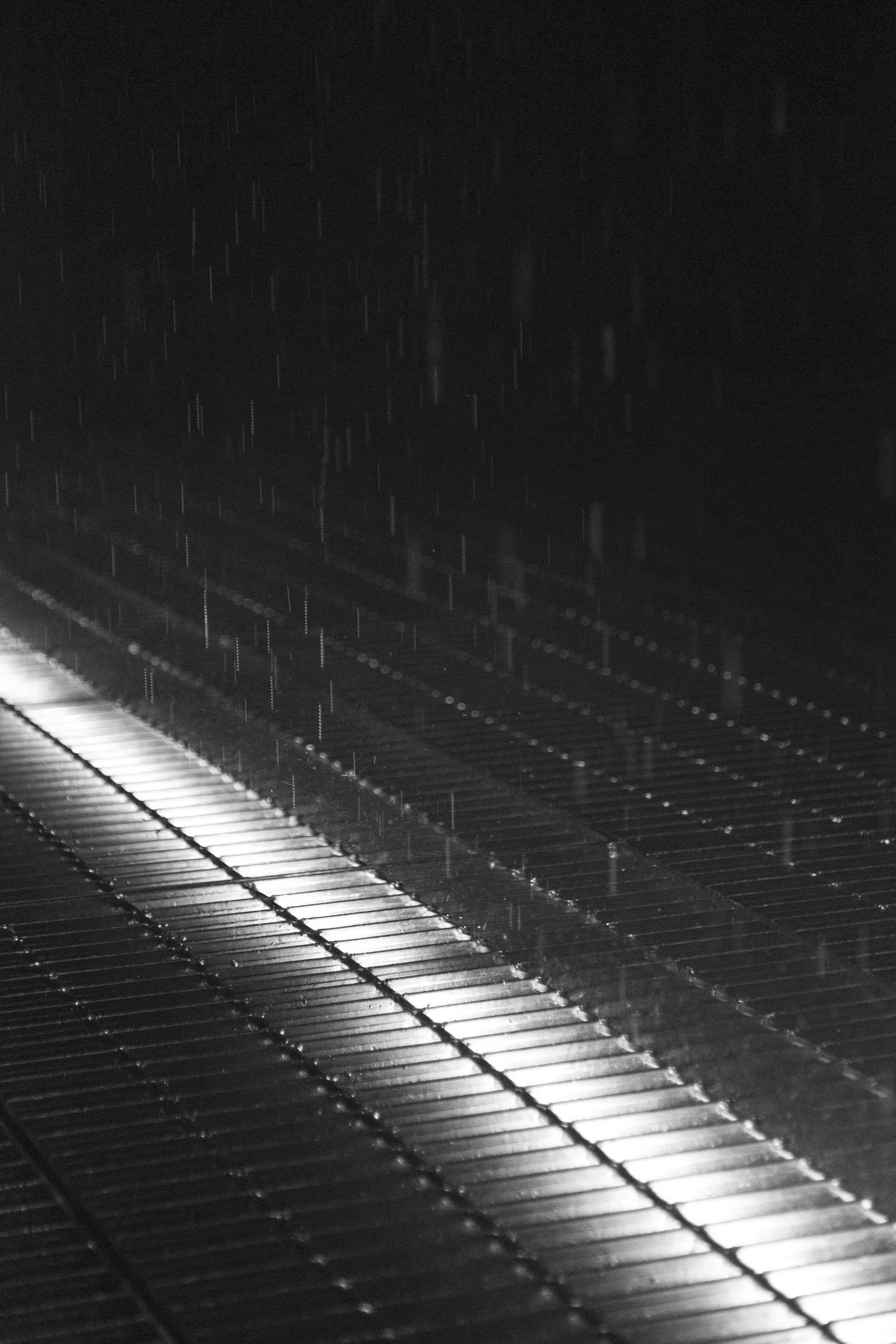
이 설치는 하나의 '덜어냄'으로 시작된다. 지붕에 형성된 좁은 틈은 빛과 물을 건물 내부로 끌어들이며, 한 줄기 빛이 들어와 지붕에서 지하로 떨어지는 빗방울의 연속을 드러낸다.
무엇을 더하기보다 덜어내는 이 개입은 특정한 조건을 활성화한다. 비어 있음은 공간을 구조화하며, 밀도와 공허 사이의 관계를 가시화한다.
시간의 흔적이 깃든 이 건물의 다공적 성질에 기반한 이 개입은, 균열과 틈을 통해 물이 침투하는 시간을 불가피한 조건으로 수용한다. 지붕의 틈은 이 과정을 하나의 명확하고 지속적인 사건으로 형식화하며 드러낸다.
관람객이 아래층에서 위층으로 이동함에 따라, 이 설치는 점차 다르게 인식된다. 멀리서 하나의 가느다란 수직선처럼 보이던 것이, 가까이 다가갈수록 실제로 공간 속에 존재하는 물리적 대상으로 전환된다.
단순한 하나의 열림은 더 이상 틈에 머무르지 않고, 공간 전체를 관통하는 하나의 축으로 작동하게 된다. 이 축을 따라 빛과 물, 그리고 중력이라는 요소들이 끊임없이 흐르고 작용하면서, 건물은 닫힌 객체가 아니라 그 안을 통과하는 것들과의 관계 속에서 끊임없이 만들어지는 과정적 공간으로 드러난다.
공간 반응성
이 설치는 건물의 수직성에 의해 형성된다. 지하에서 지붕까지의 전체 높이를 활용하여 하나의 연속된 공간적 축을 만들어내며, 틈과 낙하하는 물은 공간의 부피를 점유하기보다 드러낸다.
관람객의 동선은 이 수직적 흐름을 따른다. 작품은 각 층에서 서로 다르게 인식되며, 멀리서 하나의 선으로 보이던 것이 지하에서는 직접적이고 물리적인 경험으로 전환된다. 공간의 중심부에 위치한 이 작업은 인접한 작품들을 연결하는 기준점으로 기능하며, 전시 전체에 걸쳐 공허와 밀도 사이의 대화를 강화한다.
서사적 역할 — Density → Void / HEOSA
이 설치 작업은 Density에서 Void / HEOSA로 전환되는 순간을 드러낸다. 압축과 과잉 자극의 시간을 지나, 수직으로 열리는 공간은 빛과 물, 그리고 더 느린 리듬을 들여오며 처음으로 '풀림'의 감각을 만들어낸다. 닫혀 있던 공간은 점차 열리고, 감각될 수 있는 상태로 변화한다.
관람객이 이 공간을 지나 지하에서 물과 직접 마주하고 상호작용하게 될 때, 경험은 더욱 직접적이고 내면적인 방향으로 깊어지며 의식과 현재에 머무는 상태로 이끈다.
관객 경험 / Visitor Experience
이 설치는 공간을 고정되고 닫힌 구조로 인식하던 시선에서 벗어나, 열리고 스며드는 상태로 이해하도록 유도한다. 처음에는 단순한 제스처처럼 보이지만, 이 작업은 빛과 물, 그리고 움직임에 의해 형성되는 하나의 조건으로 작동한다.
관람객의 신체는 이 경험의 일부가 된다. 건물을 따라 이동하는 동안, 이 작업은 각 층에서 서로 다르게 인식된다 — 멀리서 하나의 선처럼 보이던 것이 점차 물질적 존재로 다가온다.
그리고 지하에 이르러, 관람객은 물에 가까이 다가가고, 만지고, 혹은 그 사이를 지나며 단순한 관찰에서 벗어나 직접적인 참여의 상태로 전환된다.
__
OPEN SECTION. 2026 Erased Studio (Belgium)
Centerhall, Void — Transitional Axis
The installation begins with a subtraction. A narrow slit in the roof opens the building to light and water, allowing a beam to enter and reveal a continuous fall of raindrops from the roof to the basement.
Rather than introducing an object, the gesture activates a condition. The void structures the space, making visible the relationship between density and emptiness.
Rooted in the building's aged and porous character, the intervention acknowledges an existing reality: water inevitably infiltrates through cracks and openings over time. The slit formalizes this process, framing it as a precise and continuous event.
As visitors move from bottom to top, the installation shifts in perception — from a distant vertical line to a physical presence that can be approached, touched, or crossed.
A simple opening becomes a spatial axis, where light, water, and gravity reveal the building not as a closed object, but as something continuously shaped by what passes through it.
Site-Specificity
The installation is shaped by the building's verticality, using the full height from basement to roof to create a continuous spatial axis. The slit and falling water reveal the volume rather than occupy it.
Visitor flow follows this vertical sequence: the piece is perceived differently at each level, from a distant line to a direct, physical experience in the basement. Positioned at the core, it acts as a constant reference point, linking adjacent works and reinforcing the dialogue between void and density throughout the exhibition.
Narrative Role — Density → Void / HEOSA
The installation marks the transition between Density and Void / HEOSA. After moments of compression and overstimulation, the vertical opening introduces light, water, and a slower rhythm, creating a first sense of release. The space shifts from something enclosed to something open and perceptible. As visitors move through and eventually interact with the water in the basement, the experience becomes more direct and introspective — guiding them into a state of awareness and presence.
Visitor Experience
The installation invites a shift from seeing space as fixed and enclosed to understanding it as open and porous. What first appears as a simple gesture becomes a condition shaped by light, water, and movement.
The visitor's body is part of this experience. Moving through the building, the work is perceived differently at each level — from a distant line to a physical presence. In the basement, visitors can approach, touch, or walk through the water, shifting from observation to direct engagement.
About the Artist / 작가 소개
Founded by Elliott Housiaux (b.1995) and Paul-Emile De Smedt (b.1995), ERASED STUDIO provides concept-led creative services rooted in architectural thinking. Through architecture, interior design, scenography, and art direction, the studio works in service of brands, institutions, agencies, and artists. Their rigorous, highly aesthetic approach binds each project together, permeating every decision with the intent of forging new and exciting narratives.
Elliott Housiaux (b.1995)와 Paul-Emile De Smedt (b.1995)가 설립한 ERASED STUDIO는 건축적 사고를 기반으로 한 개념 중심의 창의적 서비스를 제공한다. 이 스튜디오는 건축, 인테리어 디자인, 무대 디자인, 아트 디렉션을 통해 브랜드, 기관, 에이전시 및 예술가와 협업해왔다. 이들의 철저하고 높은 미적 완성도를 지향하는 접근 방식은 각 프로젝트를 유기적으로 결속시키며, 모든 과정에서 새로운 서사를 구축하려는 의도를 반영한다.
CONTRASTS
The Poetics of the In-Between
April 1 — June 28, 2026
Presented by MAISON NAVIE
Co-Creation & Spatial Design by Erased Studio
Tea Ritual Collaboration with POINT TWO FIVE·SECOND